

Introduction
Content creation is no longer just a creative process it has become an operational challenge.
Businesses today are expected to publish consistently across multiple channels. Blog posts, email campaigns, landing pages, social media content, and ad creatives all need to be produced at scale. The pressure is not just about writing well anymore, but about writing faster, consistently, and with a clear objective.
This is where tools like Copy.ai enter the conversation.
Unlike structured platforms such as Jasper AI, which are designed for full-scale content operations, Copy.ai focuses on a different problem. It aims to eliminate the friction between idea and execution by generating content quickly and in multiple variations.
At first glance, this makes it incredibly appealing especially for beginners and small teams. But speed alone does not define a good content tool.
The real question is:
Does Copy.ai actually improve your content workflow, or does it just make content production faster without improving quality?
This review takes a practical approach to answering that question.
Instead of simply listing features, we will analyze:
- How Copy.ai performs in real-world usage
- Where it creates measurable efficiency
- Where it starts to break down
- And whether it aligns with your specific content needs
What Copy.ai Is (And What It Is Not)
Understanding Copy.ai correctly is critical before evaluating it.
At its core, Copy.ai is one of the best AI Writing tools speed-focused content generation platform. It is designed to help users produce content quickly without requiring complex setup or structured workflows.
However, it is important to recognize what it is not.
Copy.ai is not a full content management system. It does not attempt to control the entire content lifecycle, nor does it enforce deep structural frameworks like some of its competitors.
Instead, it operates on a much simpler principle:
Reduce the effort required to turn an idea into usable content.
This design philosophy shapes everything about the platform.
How Copy.ai Positions Itself in the Market
To understand where Copy.ai fits, you need to look at the broader landscape.
Content tools today generally fall into three categories:
- General-purpose systems like ChatGPT that prioritize flexibility, allowing users to generate anything from content to code, but require manual structuring and guidance.
- Structured platforms like Jasper AI that focus on workflows, brand consistency, and campaign-level organization, making them suitable for teams and large-scale operations.
- Speed-focused tools like Copy.ai that emphasize quick output, ease of use, and accessibility, often at the cost of depth and structured control.
This positioning creates a clear trade-off.
Copy.ai offers:
- Faster content generation
- Lower learning curve
- Easier onboarding
But sacrifices:
- Workflow depth
- Advanced customization
- Strong brand consistency mechanisms
Core Strengths of Copy.ai (Explained Practically)
Copy.ai’s strengths are not theoretical they become clear when you start using the tool in real workflows.
- It removes the blank page problem by generating multiple content variations instantly, allowing users to start with direction instead of struggling with initial ideas or structure.
- It significantly reduces content creation time for short-form assets such as ads, captions, and product descriptions by eliminating repetitive writing tasks.
- It simplifies content creation for beginners by removing the need to understand complex frameworks, making it accessible even for users with minimal writing experience.
- It enables rapid experimentation by generating multiple variations of the same idea, which is especially useful for testing messaging in marketing campaigns.
These strengths explain why Copy.ai has gained popularity quickly, particularly among freelancers and small businesses.
Where Copy.ai Does Not Compete
While Copy.ai is effective within its scope, it is not designed to compete in every area.
- It does not provide deep workflow structuring, which makes it less suitable for managing large-scale content operations across multiple teams or campaigns.
- It lacks strong brand voice consistency systems, meaning outputs may vary in tone unless manually refined, especially when used across different types of content.
- It does not perform well in long-form, research-heavy content, where depth, originality, and context are critical for quality and authority.
- It offers limited collaboration features compared to enterprise-focused tools, which can become a bottleneck for teams managing shared content workflows.
These limitations are not flaws they are the result of deliberate product design decisions.
How Copy.ai Actually Works in Real Workflows
Most reviews describe tools based on features. That approach does not help users understand how the tool fits into daily work. That’s why ToolzReview Helps you choose the best tools for your website.
To evaluate Copy.ai properly, you need to understand how it changes the content creation process itself.
The Copy.ai Workflow Model
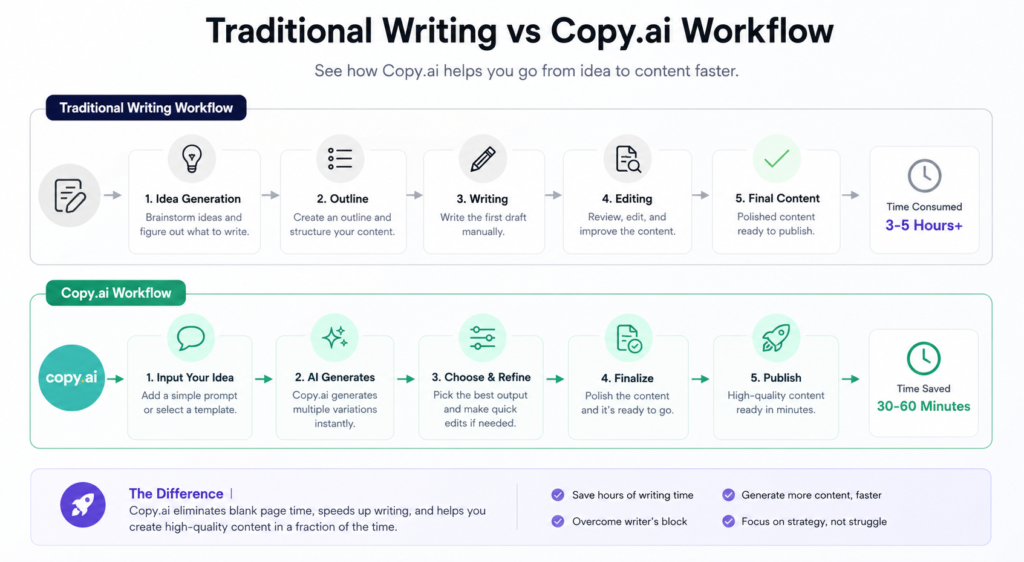
Copy.ai operates on a simple but effective loop:
Input → Generate → Compare → Refine
This may seem basic, but it introduces a meaningful shift in how content is created.
In a traditional workflow, content creation involves:
- Planning structure
- Writing drafts
- Editing heavily
With Copy.ai, the process changes.
Instead of building content from scratch, users generate multiple outputs instantly and then select the most suitable version. The focus shifts from creation to selection and refinement.
Why This Workflow Matters
This shift reduces what is known as cognitive overhead.
Cognitive overhead refers to the mental effort required to:
- Decide how to structure content
- Choose the right tone
- Organize ideas logically
Copy.ai minimizes this effort by providing ready-made outputs that users can build upon.
Real-World Impact on Productivity
In practical terms, this means:
- Content creation becomes faster because users are no longer starting from a blank page, which is often the most time-consuming part of the process.
- Decision-making becomes easier because multiple variations are available instantly, allowing users to choose rather than create from scratch.
- Iteration improves because generating alternative versions takes seconds, enabling faster experimentation with messaging and tone.
The Hidden Trade-Off
While this workflow improves speed, it also introduces a limitation.
Because users rely on generated outputs:
- Creativity can become constrained
- Content may start to feel similar over time
- Depth can be sacrificed for speed
This is why Copy.ai works best when used as:
A starting point not a complete solution
What You Should Expect Before Using Copy.ai
Before moving into deeper sections, it is important to set realistic expectations.
Copy.ai is not designed to replace writers. It is designed to assist and accelerate content production.
If you approach it expecting:
- Fully polished long-form content
- Deep insights without input
- Complete automation
You will likely be disappointed.
However, if you use it as:
- A content accelerator
- A variation generator
- A productivity tool
It can deliver significant value.
Copy.ai Templates Speed vs Depth Trade-Off
Templates are the backbone of Copy.ai. Almost every action inside the platform is built around them.
At a surface level, templates look like simple shortcuts. But in practice, they define how content is created, structured, and scaled.
Understanding how they actually behave in real workflows is essential.
How Templates Work in Practice
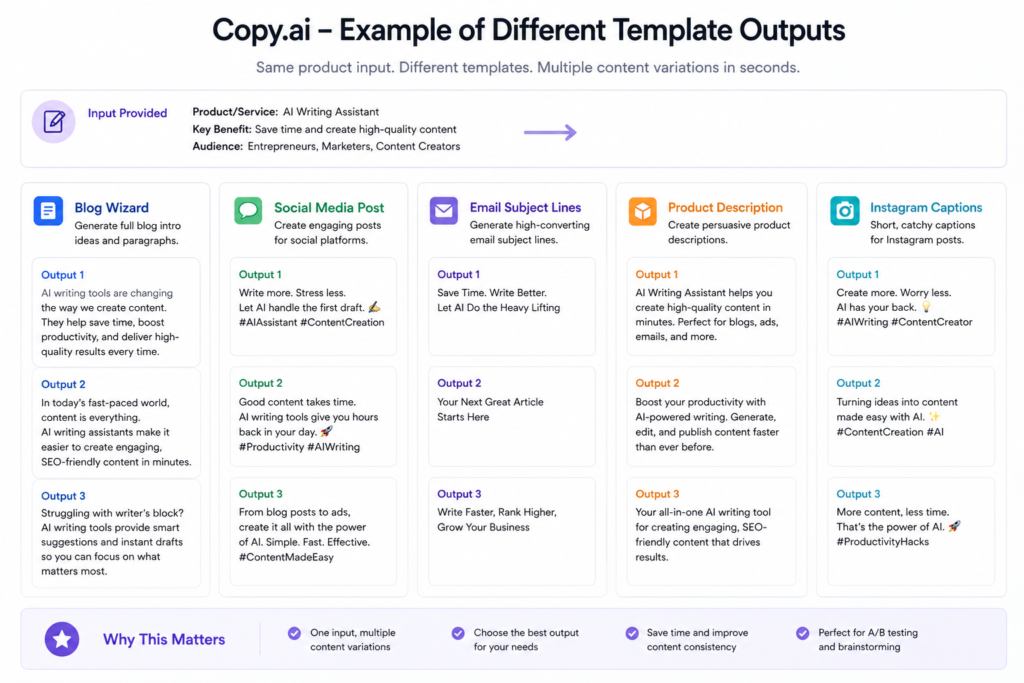
Each template is designed around a specific use case. Instead of starting from scratch, users select a template, provide minimal input, and generate multiple variations instantly.
For example:
- Social media templates focus on engagement and brevity
- Ad templates prioritize clarity and conversion
- Product description templates emphasize benefits and features
This structure removes the need to think about format, which is where a significant portion of writing time is usually spent.
Where Templates Create Real Efficiency
Templates are most effective when the goal is to produce content quickly without overthinking structure.
- They eliminate the need to decide how to begin, which is often the biggest barrier in content creation and leads to unnecessary delays in execution.
- They standardize output formats, ensuring that content follows a consistent structure without requiring manual planning or repeated formatting decisions.
- They allow rapid generation of multiple variations, making it easier to test different messaging angles for marketing campaigns without additional effort.
- They reduce mental fatigue during repetitive tasks, especially when producing high-volume content such as ads, captions, or short-form marketing assets.
This is why Copy.ai performs extremely well in high-frequency content environments.
Where Templates Start to Break Down
The same structure that creates efficiency can also create limitations.
- Templates rely on predefined patterns, which can result in repetitive phrasing and predictable content structures when used frequently across similar types of content.
- They struggle with complex topics where nuance and context matter, often producing outputs that feel generic or lack depth in explanation.
- They limit creative exploration because users are working within a predefined framework rather than building content organically from scratch.
- They are less effective for long-form content, where flexibility and deeper reasoning are required to maintain quality and engagement throughout the piece.
This creates a ceiling on how far templates can take you.
Strategic Insight: When to Use Templates
Templates should not be used blindly.
They are most effective when:
- You need fast outputs
- The content is short and structured
- The goal is efficiency, not originality
They are less effective when:
- Content requires depth or expertise
- You need a unique voice or positioning
- The topic demands detailed explanation
Output Quality Across Use Cases
One of the biggest mistakes users make is assuming Copy.ai performs equally well across all content types.
It does not.
Its performance varies significantly depending on what you are trying to create.
High-Performance Use Cases (Where Copy.ai Excels)
Copy.ai performs best when the content is short, direct, and structured.
- Social media captions are generated quickly with engaging language, making it easy to maintain consistent posting without spending excessive time on ideation.
- Ad copy variations are produced efficiently, allowing marketers to test multiple angles and optimize campaigns without manually rewriting each version.
- Email subject lines and hooks are generated with strong clarity, helping improve open rates while reducing the effort required to brainstorm compelling ideas.
In these scenarios, the output is often usable with minimal editing.
Moderate Performance Use Cases (Needs Refinement)
For mid-length content, Copy.ai acts more as a starting point than a complete solution.
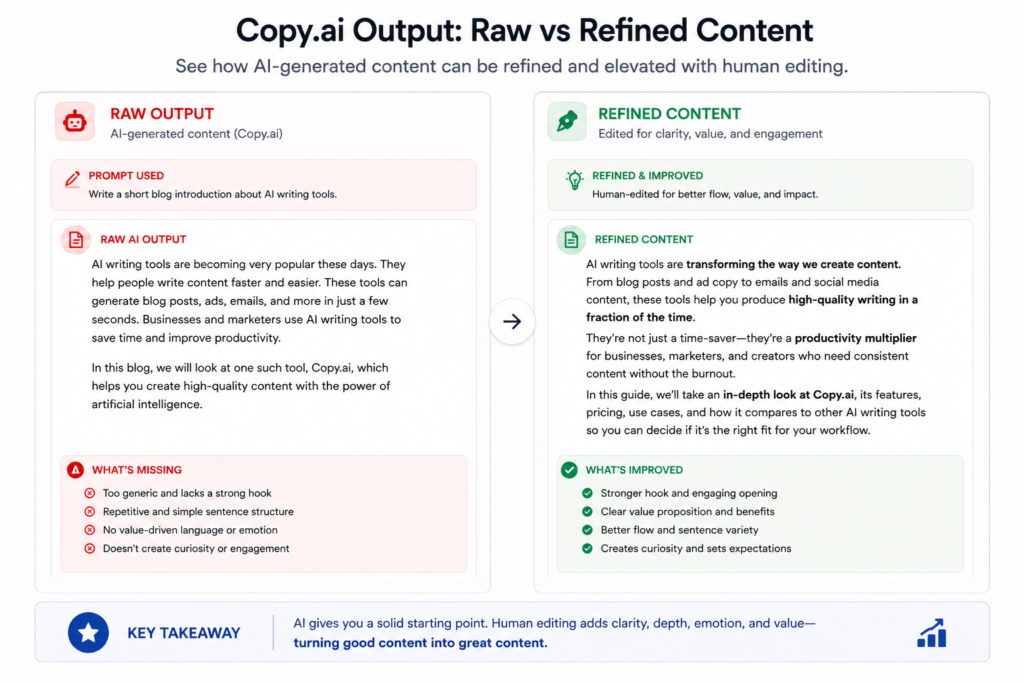
- Blog introductions are generated with clear structure but often lack depth, requiring manual expansion to make them more engaging and informative.
- Product descriptions are useful as a base but may need refinement to align with brand voice and differentiate from competitors.
- Landing page sections provide a solid framework, but messaging often needs to be sharpened for clarity and conversion.
Here, the tool saves time but does not eliminate the need for editing.
Weak Performance Areas (Where It Struggles)
Copy.ai is not designed for complex or deeply analytical content.
- Long-form blog posts often lack depth and originality, making them unsuitable for authority-building content without significant manual input.
- Technical writing tends to be oversimplified, which can reduce accuracy and credibility when dealing with specialized topics.
- Thought leadership content lacks strong positioning, as the tool does not inherently generate unique perspectives or strategic insights.
This limitation is important for SEO-focused users.
Practical Takeaway
Copy.ai is not a “write everything” tool.
It is a:
“Generate fast, refine later” tool
Understanding this will significantly improve how you use it.
Workflow Efficiency vs Creative Control
One of the most important decisions when choosing a content tool is understanding the trade-off between speed and control.
Copy.ai clearly prioritizes speed.
What You Gain
By simplifying the process, Copy.ai allows users to:
- Produce content faster by removing the need to build structure manually, which is often the most time-consuming part of writing workflows.
- Generate multiple variations instantly, making it easier to test ideas and refine messaging without starting from scratch each time.
- Maintain momentum in content production, especially when dealing with repetitive or high-volume tasks that would otherwise slow down productivity.
What You Lose
However, this efficiency comes with limitations.
- You have less control over how content is structured, which can make it harder to create highly customized or strategic pieces.
- Creative exploration is limited because the tool relies on predefined patterns rather than open-ended thinking.
- Outputs may feel similar over time, especially if templates are used repeatedly without significant manual adjustments.
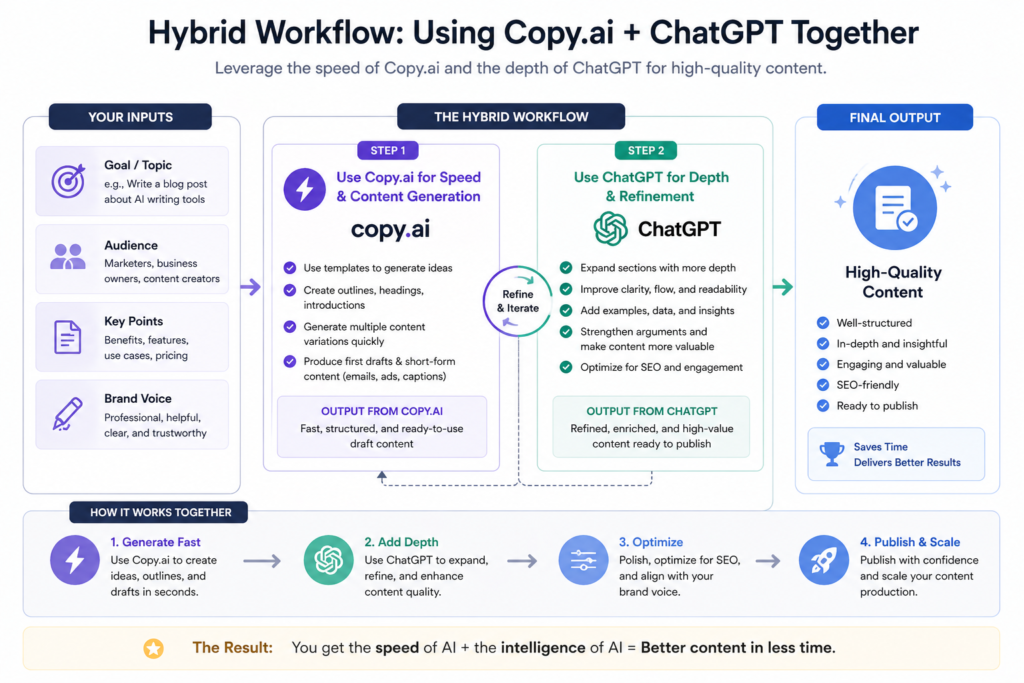
The Hybrid Workflow Strategy
Most experienced users do not rely on a single tool.
Instead, they combine tools strategically.
A common approach is:
- Use Copy.ai for fast content generation and variation creation
- Use ChatGPT for deeper thinking, refinement, and content expansion
This hybrid workflow balances:
- Speed
- Depth
- Flexibility
Why This Matters
If you try to use Copy.ai for everything, you will hit limitations quickly.
If you use it for the right tasks, it becomes a powerful productivity tool.
Transition to Next Section
So far, we’ve analyzed:
- How templates work
- Where Copy.ai performs well
- Where it struggles
- And how it fits into real workflows
But there is one major factor that influences the final decision:
Pricing and value.
Because even a good tool is not worth it if the economics don’t make sense for your use case.
Copy.ai Pricing: Cost vs Real-World Value
Pricing is often the first filter users apply when evaluating a tool like Copy.ai.
At a surface level, Copy.ai positions itself as an accessible alternative to premium platforms like Jasper AI. But to understand whether it’s actually worth the cost, you need to look beyond the monthly price and evaluate how it impacts your workflow.
Current Pricing Plans (2026)
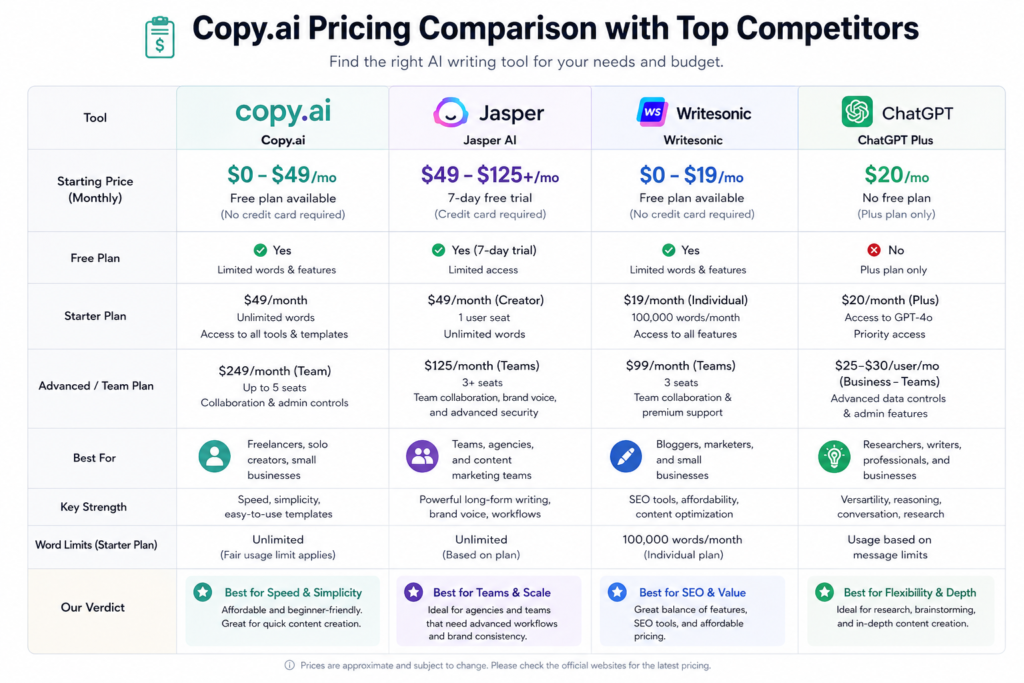
Copy.ai follows a freemium + subscription model, designed to lower the entry barrier while encouraging upgrades for higher usage.
Free Plan
- $0/month
- Limited word generation
- Access to basic tools and templates
- Suitable for testing or occasional use
Starter Plan
- ~$49/month
- Unlimited words (with fair usage limits)
- Access to all templates and tools
- Ideal for freelancers and individual creators
Advanced / Team Plans (if applicable)
- Custom pricing depending on usage and team size
- Additional collaboration and workflow features
- Designed for growing teams and businesses
(Note: Pricing may vary slightly based on promotions or annual billing discounts.)
What You’re Actually Paying For
Unlike structured platforms, Copy.ai’s pricing is not built around advanced infrastructure or workflow systems.
Instead, you are paying for:
- Faster content generation
- Access to a large library of templates
- The ability to produce multiple variations instantly
This positions Copy.ai as a content acceleration tool, not a full-scale content operations platform.
When Copy.ai Pricing Makes Sense
The pricing becomes justifiable when the tool directly improves how quickly you can produce content.
- It delivers strong value for freelancers who handle multiple small projects, where saving even a few hours per week can offset the monthly subscription cost.
- It works well for small businesses that rely on consistent short-form content, as the ability to generate ideas and variations quickly improves overall marketing output.
- It is particularly useful when speed is a priority, allowing users to execute content tasks faster without investing in more complex systems.
When Pricing Becomes a Limitation
Despite being affordable compared to competitors, Copy.ai can feel limited in certain scenarios.
- For agencies managing multiple clients, the lack of advanced workflow control and brand consistency tools can lead to inefficiencies that outweigh the cost savings.
- For content-heavy businesses, the need to combine Copy.ai with other tools (for SEO, collaboration, or long-form writing) can increase the total cost of the stack.
- For users expecting a complete solution, the platform may feel underpowered relative to its subscription price.
Cost vs Value: The Real Perspective
The real value of Copy.ai is not in how much it costs—it’s in how much time it saves.
If you are:
- Writing frequently
- Producing repetitive content
- Focused on execution speed
Then the tool can easily justify its price.
But if your workflow depends on:
- Deep research
- Content strategy
- High-quality long-form writing
Then the return on investment becomes less clear.
Copy.ai vs Competitors: A Practical Positioning Analysis
To make a confident decision, it is important to understand how Copy.ai compares to other tools in the market.
| Tool | Core Strength | Best Use Case | Structure | Flexibility | Pricing Position |
| Copy.ai | Speed & simplicity | Beginners, freelancers | Medium | High | Affordable |
| ChatGPT | Versatility & ideation | Research, brainstorming | Low | Very High | Mid-range |
| Jasper AI | Structured workflows | Teams, agencies | High | Medium | Premium |
| Writesonic | SEO-focused writing | Bloggers, marketers | Medium | High | Affordable |
This table is not about which tool is better it is about which tool fits your workflow.
- Copy.ai focuses on fast execution, making it ideal for users who want quick outputs without complexity.
- ChatGPT excels in flexibility, allowing users to explore ideas and refine content with greater control.
- Jasper AI stands out for structured workflows, making it more suitable for teams managing large-scale content operations.
- Writesonic positions itself between speed and SEO, offering more optimization features for users focused on search-driven content.
Is Copy.ai Worth It?
This is one of the most important questions users ask and one of the most important sections for SEO.
The answer depends entirely on how you create content.
Copy.ai Is Worth It If:
- You need to produce content quickly and consistently, especially for short-form formats like ads, captions, and email hooks.
- You are a beginner or solo creator looking for a simple tool that removes the complexity of structured writing workflows.
- You want to reduce time spent on repetitive writing tasks without investing in more advanced and expensive platforms.
Copy.ai Is Not Worth It If:
- You require deep, research-based content that demands originality, analysis, and strong positioning to perform well in competitive environments.
- You manage large-scale content operations where consistency, collaboration, and workflow control are critical for maintaining quality.
- You expect a single tool to handle everything from ideation to execution without needing additional support or refinement tools.
Is Copy.ai Better Than ChatGPT?
This is a common comparison but it is often misunderstood.
Copy.ai and ChatGPT are designed for different purposes.
- Copy.ai is optimized for speed and ready-made outputs, making it ideal for users who want immediate results without building prompts from scratch.
- ChatGPT is optimized for thinking and exploration, allowing users to refine ideas, generate insights, and work through complex content creation tasks.
Practical Answer
If your workflow is:
- “Give me quick content” → Copy.ai is more efficient
If your workflow is:
- “Help me think and build content” → ChatGPT is more effective
Does Copy.ai Help with SEO?
This is a critical question for bloggers and marketers.
The short answer is: partially, but not completely.
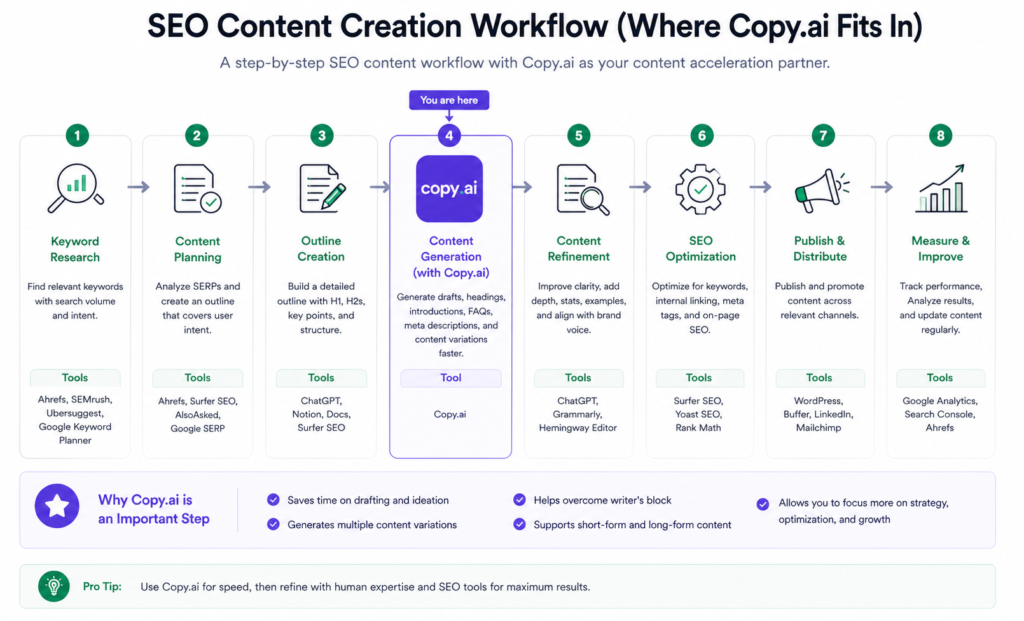
What Copy.ai Can Do for SEO
- It can generate content outlines quickly, helping you structure articles without spending too much time on planning.
- It can create initial drafts that serve as a starting point for further optimization and refinement.
- It can assist with meta descriptions, headlines, and short-form SEO elements that require clarity and conciseness.
What Copy.ai Cannot Do
- It cannot build topical authority, which requires depth, internal linking, and strategic content planning.
- It does not provide advanced SEO optimization features such as keyword scoring or content grading.
- It cannot replace dedicated SEO tools or manual research required for ranking competitive content.
When Copy.ai Becomes a Competitive Advantage
Copy.ai becomes highly effective when used in the right context.
- It significantly improves productivity in high-volume content environments, where speed and consistency are more important than depth or originality.
- It reduces the effort required for repetitive tasks, allowing teams to focus on strategy rather than execution.
- It enables faster testing of marketing messages, which is critical for optimizing campaigns and improving performance over time.
When Copy.ai Becomes a Limitation
The same strengths that make Copy.ai efficient can also become limitations.
- It struggles with content that requires deep thinking, making it less suitable for authority-building blog posts or research-driven articles.
- It lacks advanced workflow features, which can create inefficiencies for teams managing complex content operations.
- It does not enforce strong brand consistency, requiring manual effort to maintain tone and messaging across different pieces of content.
Final Verdict: Should You Use Copy.ai?
Copy.ai is not trying to be the most advanced tool and that is exactly why it works.
It is designed for:
- Speed
- Simplicity
- Accessibility
But it is not designed for:
- Depth
- Structure
- Large-scale content systems
Who Should Use Copy.ai
- Freelancers and solo creators who need fast content generation without complexity
- Small businesses looking to improve productivity without investing in expensive tools
- Marketers focused on short-form content such as ads, emails, and social media
Who Should Avoid Copy.ai
- Agencies managing multiple clients with strict brand consistency requirements
- Businesses producing high-quality, research-driven content at scale
- Users looking for a complete content system rather than a content generation tool
Frequently Asked Questions (FAQs)
1. What is Copy.ai used for?
Copy.ai is primarily used to generate short-form content quickly and efficiently. It helps users create marketing copy such as social media captions, ad variations, email subject lines, and product descriptions without starting from scratch.
Instead of manually structuring content, users can rely on pre-built templates to produce multiple variations within seconds, making it especially useful for repetitive writing tasks.
2. Is Copy.ai good for beginners?
Yes, Copy.ai is one of the most beginner-friendly writing tools available. The interface is simple, and most features are built around guided templates, which reduces the learning curve significantly.
Unlike tools that require prompt engineering or technical understanding, Copy.ai allows users to generate content by simply filling in basic inputs, making it ideal for freelancers, small business owners, and non-technical users.
3. Is Copy.ai better than ChatGPT?
ChatGPT and Copy.ai serve different purposes, so one is not universally better than the other.
Copy.ai is better for users who want quick, ready-made content using templates, while ChatGPT is more suitable for brainstorming, detailed writing, and complex problem-solving.
In many workflows, both tools are used together Copy.ai for speed and ChatGPT for refinement and depth.
4. Can Copy.ai write full blog posts?
Copy.ai can generate blog outlines and initial drafts, but it is not ideal for producing complete, high-quality long-form articles without editing.
The generated content often lacks depth, originality, and detailed insights, which are necessary for SEO performance and authority-building. For best results, it should be used as a starting point rather than a complete writing solution.
5. Does Copy.ai help with SEO?
Copy.ai can assist with certain parts of SEO, such as generating outlines, meta descriptions, and initial drafts. However, it does not provide advanced optimization features like keyword analysis, content scoring, or SERP insights.
For effective SEO results, Copy.ai should be combined with dedicated SEO tools and manual research to create content that is both optimized and valuable.
6. Is Copy.ai free to use?
Yes, Copy.ai offers a free plan with limited usage, allowing users to test the platform before upgrading to a paid plan.
The free version is suitable for occasional use, but users who need higher output limits and more consistent content production may need to upgrade to a paid plan.
Leave a Reply